Missouri Franchisee and Franchisor Restaurant INSURANCE
OR call us: (214) 667-2729
Running a franchise restaurant in Missouri means juggling two sets of expectations: your franchisor's brand standards and the state's own regulatory requirements. A single kitchen fire, a slip-and-fall lawsuit, or a data breach at your POS system can threaten both your investment and the broader franchise brand. The insurance you carry isn't just a line item on your budget; it's the financial backbone that keeps your doors open after a crisis. Missouri's regulatory environment has its own quirks, from specific
workers' compensation rules to a brand-new cybersecurity reporting law that took effect in January 2026. Whether you're a franchisee operating a single
burger joint in Springfield or a franchisor expanding a barbecue concept across the Kansas City metro, your insurance portfolio needs to reflect both your operational reality and your contractual obligations. Getting this wrong can mean denied claims, broken franchise agreements, or personal financial exposure you never anticipated. This guide breaks down the coverage types, legal requirements, and
risk-sharing strategies that matter most for
restaurant insurance in Missouri's franchise world.
Missouri sits at a crossroads for franchise restaurant growth, with population centers like St. Louis, Kansas City, and Columbia driving steady demand for quick-service and casual dining concepts. That growth comes with a specific regulatory environment that shapes what insurance you need and how you structure it. The state treats franchisors and franchisees as distinct legal entities with separate obligations, which means your coverage can't be one-size-fits-all.
Missouri requires franchisors to register and comply with state-specific franchise disclosure requirements before selling franchise units. Those registration documents often dictate minimum insurance thresholds. Understanding this framework is the first step toward building a policy portfolio that satisfies both state law and your franchise agreement.
The Role of Franchise Disclosure Documents (FDD) in Insurance
Your FDD isn't just a legal formality. Item 8 of every FDD spells out the insurance requirements a franchisee must maintain, often specifying minimum limits for general liability, property coverage, and workers' compensation. Some franchisors require $1 million per occurrence in general liability and $2 million aggregate, but others push for higher thresholds depending on the concept's risk profile.
Franchisees who ignore these requirements risk termination of their franchise agreement. Franchisors who fail to enforce them risk vicarious liability exposure if a franchisee's underinsured claim spills over into a brand-wide lawsuit. Both sides should treat the FDD's insurance section as a living document, revisiting it annually as operations change.
Missouri-Specific Workers' Comp and Liability Mandates
Missouri requires most employers with five or more employees to carry workers' compensation insurance. For restaurants, where burns, cuts, and repetitive motion injuries are common, this isn't optional. The state's Division of Workers' Compensation sets the rules, and penalties for non-compliance include fines and personal liability for the business owner.
Liability requirements go beyond workers' comp. Missouri follows a pure comparative fault system, meaning your restaurant can be held partially liable even if the injured party shares blame. A customer who slips on a wet floor but was texting while walking can still recover damages proportional to your fault. This makes your general liability limits critically important, and $1 million per occurrence is often the bare minimum for a busy franchise location.

By: Dustin Hulett
Founder & CEO of Cuisine Coverage
Core Coverages for Franchisees and Franchisors
Building the right insurance stack for a Missouri franchise restaurant means understanding which policies protect against which risks. Not every coverage type applies equally to franchisees and franchisors, and some policies overlap in ways that create either gaps or redundancies.
General Liability vs. Professional Liability for Food Service
General liability covers bodily injury and property damage claims: a customer who breaks a tooth on a bone fragment, a delivery driver who trips on your loading dock, or a grease fire that damages the neighboring tenant's space. Most franchise agreements require $1 million per occurrence and $2 million aggregate, with typical annual premiums ranging from $2,500 to $7,000 depending on your location, sales volume, and claims history.
Professional liability, sometimes called errors and omissions coverage, is less common for individual restaurant locations but matters for franchisors. If your corporate team provides nutritional guidance, menu consulting, or operational training that leads to a foodborne illness outbreak, professional liability responds where general liability might not. Franchisors offering consulting services to their franchisees should carry at least $1 million in professional liability coverage.
Business Interruption and Food Spoilage Protection
A kitchen fire that shuts you down for three months doesn't just cost you repair bills. You're still paying rent, loan payments, and key employee salaries while generating zero revenue. Business interruption insurance replaces lost income during covered shutdowns, and most policies kick in after a 48- to 72-hour waiting period.
Food spoilage coverage is a separate but related protection. A power outage or equipment failure that ruins $5,000 worth of protein and produce is a real financial hit for a single-unit franchisee. Most Business Owner's Policies (BOPs) include food spoilage as a sub-limit, typically $5,000 to $25,000, but you may need to increase that limit if you operate a high-volume location with significant cold storage.
Comparing Essential Policy Types
This table breaks down the most common policy types for Missouri franchise restaurants and highlights key differences between franchisee and franchisor needs.
| Coverage Type | Typical Limit | Annual Premium Range | Who Needs It |
|---|---|---|---|
| General Liability | $1M per occurrence / $2M aggregate | $2,500 - $7,000 | Both |
| Workers' Compensation | State-mandated | $3,000 - $12,000 | Franchisees (employers) |
| Commercial Property | Replacement cost | $1,500 - $5,000 | Franchisees |
| Business Interruption | 12 months lost income | Included in BOP or $500 - $2,000 | Both |
| Professional Liability | $1M per occurrence | $1,200 - $4,000 | Primarily franchisors |
| Cyber Liability | $1M per occurrence | $1,000 - $3,500 | Both |
| Liquor Liability | $1M per occurrence | $2,000 - $6,000 | Locations serving alcohol |
| EPLI | $1M per occurrence | $800 - $3,000 | Both |
Bundling general liability, commercial property, and business interruption into a BOP often saves 10-15% compared to purchasing each policy separately. That said, franchisors with
specialized coverage needs often require standalone policies that exceed what a standard BOP offers.
One of the trickiest aspects of franchise restaurant insurance in Missouri is determining where the franchisee's risk ends and the franchisor's begins. Courts have increasingly scrutinized the level of control a franchisor exercises over daily operations when deciding vicarious liability claims.
Structuring 'Additional Insured' Endorsements
Most franchise agreements require the franchisee to name the franchisor as an additional insured on their general liability policy. This endorsement gives the franchisor coverage under the franchisee's policy for claims arising from the franchisee's operations. The cost is minimal, usually $50 to $200 per year, but the protection is significant.
The catch is that additional insured status only extends to claims caused by the named insured's actions. If a franchisor's own negligence, like a flawed recipe or unsafe equipment specification, causes the injury, the franchisee's policy won't cover the franchisor. Both parties need their own primary coverage, with the additional insured endorsement serving as a secondary layer.
Indemnification Clauses in Franchise Agreements
Indemnification clauses in franchise agreements typically require the franchisee to hold the franchisor harmless for claims arising from the franchisee's operations. These clauses work alongside insurance but don't replace it. A franchisee without adequate coverage who signs a broad indemnification clause is essentially promising to pay out of pocket for any claim the franchisor faces due to the franchisee's actions.
Missouri courts generally enforce indemnification clauses in franchise agreements, but they won't enforce clauses that attempt to indemnify a party against its own negligence unless the language is explicit and unambiguous. Have your attorney review these clauses before signing, and make sure your insurance limits can actually back up the promises you're making.
Common Questions About Missouri Restaurant Coverage
Does my franchisor's insurance cover my individual location? No. Franchisor policies typically cover corporate operations, brand defense, and franchisor-specific liabilities. Your location needs its own general liability, property, and workers' comp policies.
How much does restaurant insurance cost in Missouri? A single-unit franchise restaurant typically pays between $8,000 and $25,000 annually for a comprehensive package including general liability, property, workers' comp, and business interruption. High-volume locations serving alcohol pay more.
Can I choose my own insurance carrier? Most franchise agreements allow you to choose your carrier as long as the policy meets FDD-specified minimums. Some franchisors operate group insurance programs that offer discounted rates, but participation is usually optional.
What happens if I'm underinsured and a claim exceeds my limits? You're personally responsible for the difference, and your franchisor may terminate your franchise agreement for non-compliance with insurance requirements. Umbrella policies, starting around $500 per year for $1 million in coverage, are a cost-effective way to close this gap.
Do I need cyber liability insurance for a restaurant? Yes. Missouri's Insurance Data Security Act, effective January 1, 2026,
requires regulated entities to report cybersecurity events within four business days of determination. POS systems, loyalty programs, and online ordering platforms all store customer data that hackers target.
Cyber Liability and Missouri's New Data Security Law
The Missouri Insurance Data Security Act changed the compliance picture for every restaurant handling digital payments. The law's four-business-day reporting window for cybersecurity incidents means you need both a response plan and insurance that covers forensic investigation, customer notification, and legal defense costs.
Cyber liability policies for restaurants typically cost $1,000 to $3,500 annually for $1 million in coverage. Given that the average cost of a data breach in the food service industry exceeds $100,000 when you factor in forensic analysis, credit monitoring, and regulatory fines, this is one of the most cost-effective policies you can carry.
You don't have to accept the first quote you receive. Installing a commercial fire suppression system can reduce your property insurance premium by 5-15%. Maintaining ServSafe certifications for your management team signals lower food safety risk to underwriters. Bundling policies into a BOP almost always saves money compared to buying standalone coverage.
Tracking your claims history matters too. A three-year period with zero workers' comp claims can qualify you for experience modification rate discounts that save thousands annually. Documenting your safety protocols, from wet floor signage to knife handling training, gives your broker ammunition to negotiate better rates on your behalf.
Specialized Equipment and Property Considerations
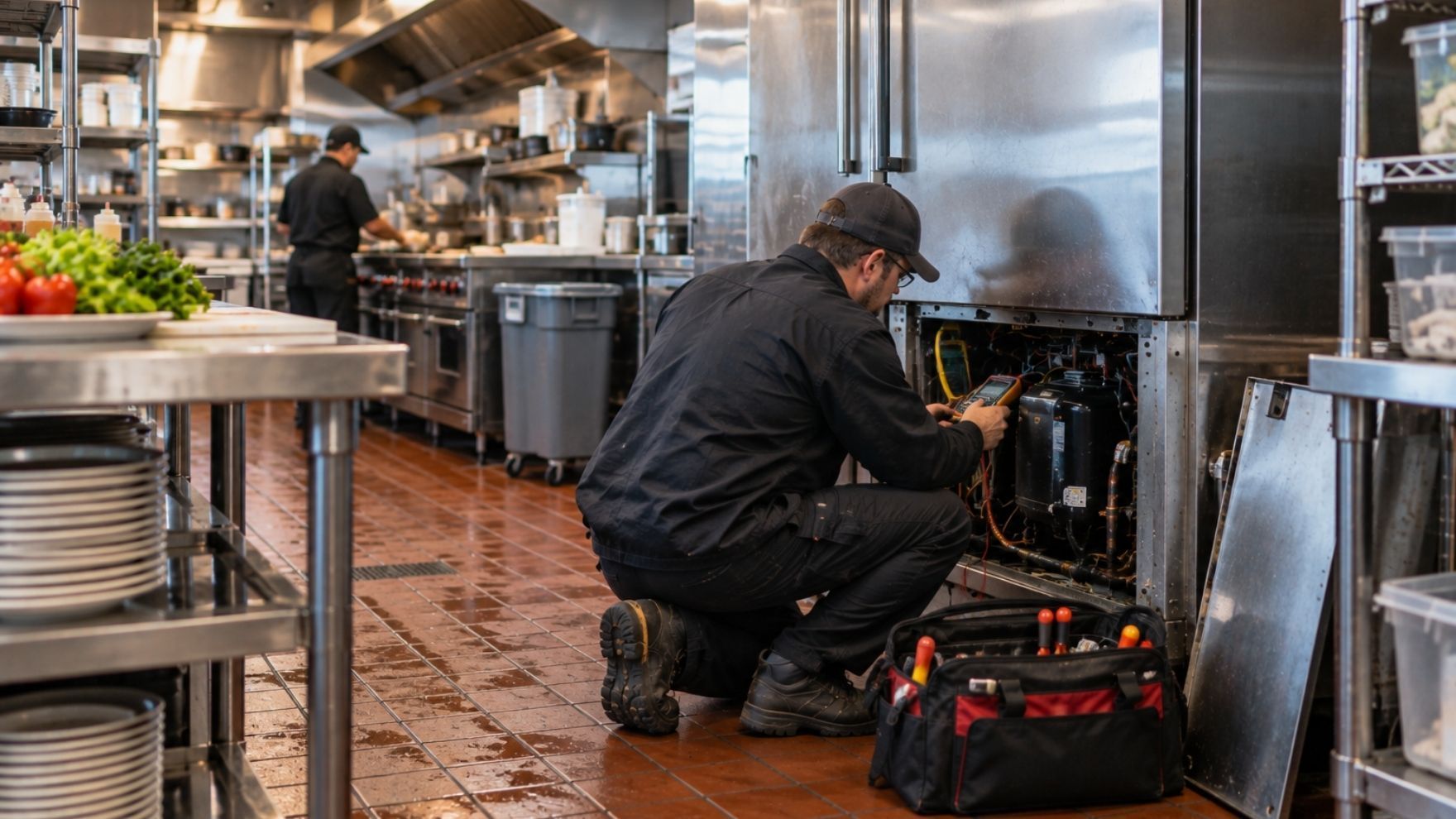
Franchise restaurants often contain specialized commercial equipment worth $100,000 or more, from walk-in coolers and commercial fryers to branded signage and custom interior buildouts. Standard commercial property policies may undervalue this equipment unless you provide a detailed inventory with replacement costs.
Request a guaranteed replacement cost endorsement rather than accepting actual cash value coverage. The difference matters: a five-year-old convection oven with an actual cash value of $3,000 might cost $9,000 to replace. Document every piece of equipment, including serial numbers and purchase receipts, and update your inventory annually.
When to Work with a Franchise-Specialized Broker
General insurance agents can write restaurant policies, but they may not understand the specific requirements embedded in your franchise agreement. A broker who specializes in franchise restaurant insurance knows how to read an FDD's insurance section, structure additional insured endorsements correctly, and identify coverage gaps that generic policies miss.
Look for brokers who work with multiple carriers and can shop your account across at least three to five markets. Ask whether they have experience with your specific franchise brand, since each franchisor has different insurance expectations. The right broker pays for themselves through better coverage terms and lower premiums.
Making the Right Choice for Your Location
Your insurance portfolio should reflect the specific risks of your Missouri franchise location, not just the minimums in your franchise agreement. A high-traffic St. Louis location with a full bar faces different exposures than a drive-through-only concept in Joplin. Start by reviewing your FDD's insurance requirements, then layer on coverages that address your actual operational risks: cyber liability, employment practices liability, and umbrella coverage being the most commonly overlooked.
Get quotes from at least three carriers, work with a broker who understands franchise structures, and revisit your coverage annually as your sales volume and employee count change. The goal isn't to spend the least on insurance. It's to make sure a single bad event doesn't wipe out the investment you've made in your franchise. A well-structured insurance program protects your income, your employees, and the brand you've committed to building.
About The Author:
Dustin Hulett
As Owner of Cuisine Coverage powered by Hulett Insurance, I specialize in protecting restaurants, bars, and hospitality businesses with smart, reliable insurance solutions. With years of experience serving the food and beverage industry, my goal is to make coverage simple, transparent, and built around the unique risks that owners face every day.
Contact Us
Business Coverage
Protection for Every Part of Your Food Business
Cuisine Coverage provides specialized insurance for restaurants, food trucks, catering services, and other hospitality businesses. We help owners protect their property, staff, and reputation with policies built around the most common industry risks.

General Liability Insurance
Protects your business from claims related to injury, property damage, or accidents that happen during operations.
General Liability
Liquor Liability Insurance
Covers alcohol-related incidents for restaurants, bars, or venues that serve or sell alcohol.
Liquor Liability
Workers Compensation Insurance
Provides wage replacement and medical benefits to employees injured on the job.
Workers Compensation
Business Interruption Insurance
Helps replace lost income and cover ongoing expenses if your business operations are temporarily halted.
Business Interruption
Product Liability Insurance
Protects against claims related to foodborne illness, contamination, or product defects.
Product Liability
Cyber Liability Insurance
Covers data breaches, online payment issues, and digital risks that can affect modern food businesses.
Cyber Liability
Serving the Food and Hospitality Industry
Insurance Solutions for Every Type of Food Business
Cuisine Coverage provides specialized insurance for restaurants, cafés, and food service professionals across the country. Whether you run a casual kitchen or a mobile food truck, we offer coverage that fits your operations and risk level.
How It Works
Insurance Made Easy for Food Business Owners
We know you don’t have time to deal with complicated insurance forms. That’s why our process is built for speed and simplicity — so you can get back to running your kitchen.
Your Insurance Questions Answered
What Restaurant and Food Business Owners Ask Most
What types of insurance do restaurants and food businesses need?
Most food businesses need general liability, property, and workers’ compensation coverage. These protect against injuries, equipment damage, and employee-related incidents. Businesses serving alcohol should also include liquor liability insurance for extra protection.
Having the right mix of policies helps reduce financial risks. We’ll help you identify the specific coverages your business needs based on your setup, size, and operations.
Do you provide insurance for food trucks and mobile kitchens?
Yes. We specialize in insurance for food trucks, trailers, and mobile vendors. Our coverage includes vehicle protection, cooking equipment, and liability for events or customer interactions.
We can also help you meet licensing and vendor requirements by issuing certificates of insurance quickly — often the same day.
How fast can I get a quote or start coverage?
In most cases, quotes are ready within 24 hours once we have your business details. After approval, coverage and certificates can be issued immediately.
Our process is fully digital but supported by real agents who review each policy for accuracy. You’ll always know exactly what you’re getting before coverage starts.
Do you offer liquor liability insurance for bars or restaurants?
Yes. We provide liquor liability insurance for bars, taverns, and restaurants that sell or serve alcohol. This coverage protects against claims involving intoxicated patrons or alcohol-related incidents.
It’s essential for maintaining compliance with local laws and protecting your business from costly lawsuits. We’ll ensure your policy meets all licensing requirements.
How can I reduce my insurance costs?
You can often lower premiums by bundling multiple coverages, maintaining clean safety records, and conducting regular policy reviews. Many insurers also offer discounts for installing safety systems and training employees.
At Cuisine Coverage, we proactively review your policy before renewal to help you keep costs down without reducing protection.
Do you help with certificates of insurance (COIs)?
Yes. We provide same-day certificates for vendors, landlords, and event partners. You can request them by phone or email anytime.
Having your COI ready keeps your business compliant and avoids delays in operations. Our team handles these requests quickly so you can stay focused on running your business.
From the Kitchen to Coverage
Real Advice for the Food and Hospitality Industry
We share tips, updates, and real-world stories from the food and insurance industries. Whether you’re managing a restaurant or rolling out a food truck, our articles give you useful guidance to protect your business and grow with confidence.
Contact Us
Phone
Location