Restaurant Franchise Owner INSURANCE
OR call us: (214) 667-2729
Opening a restaurant franchise means inheriting a proven brand, a tested menu, and a playbook for daily operations. It also means inheriting risk. Grease fires, slip-and-fall lawsuits, employee injuries, foodborne illness claims: these aren't hypothetical scenarios. They're Tuesday. And the insurance you carry determines whether a single bad incident costs you a deductible or your entire investment.
Getting the right insurance coverage as a franchise restaurant owner is more complicated than insuring an independent restaurant. Your franchisor dictates minimum coverage types and limits through the Franchise Disclosure Document (FDD), your landlord likely has separate requirements, and your state imposes its own mandates. Layer in the specifics of your concept, whether you're running a quick-service counter or a full-service dining room with a bar, and you're looking at a patchwork of policies that need to fit together tightly.
The financial stakes are real. Quick-service franchises without alcohol service
typically carry annual premiums between $3,000 and $6,000, while full-service concepts with a bar can
expect annual costs of $7,000 to $15,000 or more. Understanding what you need, what your franchisor requires, and where you have room to customize is the difference between being properly protected and paying for coverage gaps out of pocket.
Understanding Franchise-Mandated vs. Optional Coverage
Every franchise system spells out insurance requirements in the FDD. These aren't suggestions. Failing to maintain the required coverage can put you in default of your franchise agreement, giving the franchisor grounds to terminate your license. Before you shop for policies, pull out your FDD and read the insurance section line by line.
Meeting FDD Insurance Requirements
Your FDD will list specific policy types, minimum coverage limits, and sometimes even approved carriers. Typical requirements include general liability (often $1 million per occurrence / $2 million aggregate), commercial property, workers' compensation, and umbrella coverage. Some franchisors go further. McDonald's, for example, operates Golden Arches Insurance Ltd. (GAIL), a wholly-owned subsidiary that provides standardized coverage across its franchise network. Subway's 2026 FDD indicates that new franchisees should budget $1,500 to $7,500 for initial insurance premiums before opening day. According to industry standards, the $1 million per occurrence and $2 million aggregate limit is the baseline for Quick Service Restaurants (QSR) and casual dining (https://theinsurancekitchen.com/how-much-general-liability-coverage-do-restaurants-actually-need/).
Naming the Franchisor as an Additional Insured
Nearly every franchise agreement requires you to add the franchisor as an additional insured on your general liability and umbrella policies. This gives the franchisor protection if a lawsuit at your location names the brand. Your insurance agent needs to issue a certificate of insurance (COI) directly to the franchisor, and most franchise systems require updated COIs annually. Missing this step is one of the fastest ways to receive a compliance notice from corporate.
Naming Your Landlord
Your commercial lease will almost certainly require you to name the landlord as an additional insured as well, with minimum liability limits that may differ from your franchisor's requirements. Check both documents side by side. If your landlord requires $2 million per occurrence but your franchisor only requires $1 million, you'll need to meet the higher threshold.

By: Dustin Hulett
Founder & CEO of Cuisine Coverage
Foundational Liability Policies for Daily Operations
Liability coverage is the backbone of restaurant insurance for franchise owners. These policies protect you when someone gets hurt, gets sick, or sues you for damages connected to your operation.
General Liability: Slips, Falls, and Third-Party Injuries
A customer slips on a freshly mopped floor. A delivery driver trips over a mat at your entrance. A child burns their hand on a hot plate. General liability covers bodily injury and property damage claims from non-employees on your premises. For Quick Service Restaurants (QSR) and casual dining, the $1 million per occurrence and $2 million aggregate limit is the baseline requirement (https://theinsurancekitchen.com/how-much-general-liability-coverage-do-restaurants-actually-need/). Your premium depends on your location's square footage, foot traffic, and claims history.
Product Liability: Foodborne Illness and Contamination
Product liability covers claims arising from the food and beverages you serve. If a batch of contaminated lettuce triggers a norovirus outbreak traced to your restaurant, product liability responds. This coverage is often bundled into your general liability policy, but confirm the language with your agent. Allergen-related claims have increased sharply in recent years, and a single hospitalization from an undisclosed allergen can generate a six-figure lawsuit.
Liquor Liability for Full-Service Concepts
If your franchise concept serves alcohol, you need liquor liability coverage. This protects you if a patron you served causes harm after leaving your establishment. Dram shop laws vary by state, but the financial exposure is significant. A single drunk-driving accident linked to your restaurant can produce claims well beyond your general liability limits. Liquor liability is the primary reason full-service restaurants with bars pay substantially higher premiums than quick-service operations.
Protecting Your Physical Assets and Inventory
Your physical location, equipment, and inventory represent a major capital investment. A single fire, flood, or equipment failure can shut you down for weeks or months.
Commercial Property and Kitchen Equipment
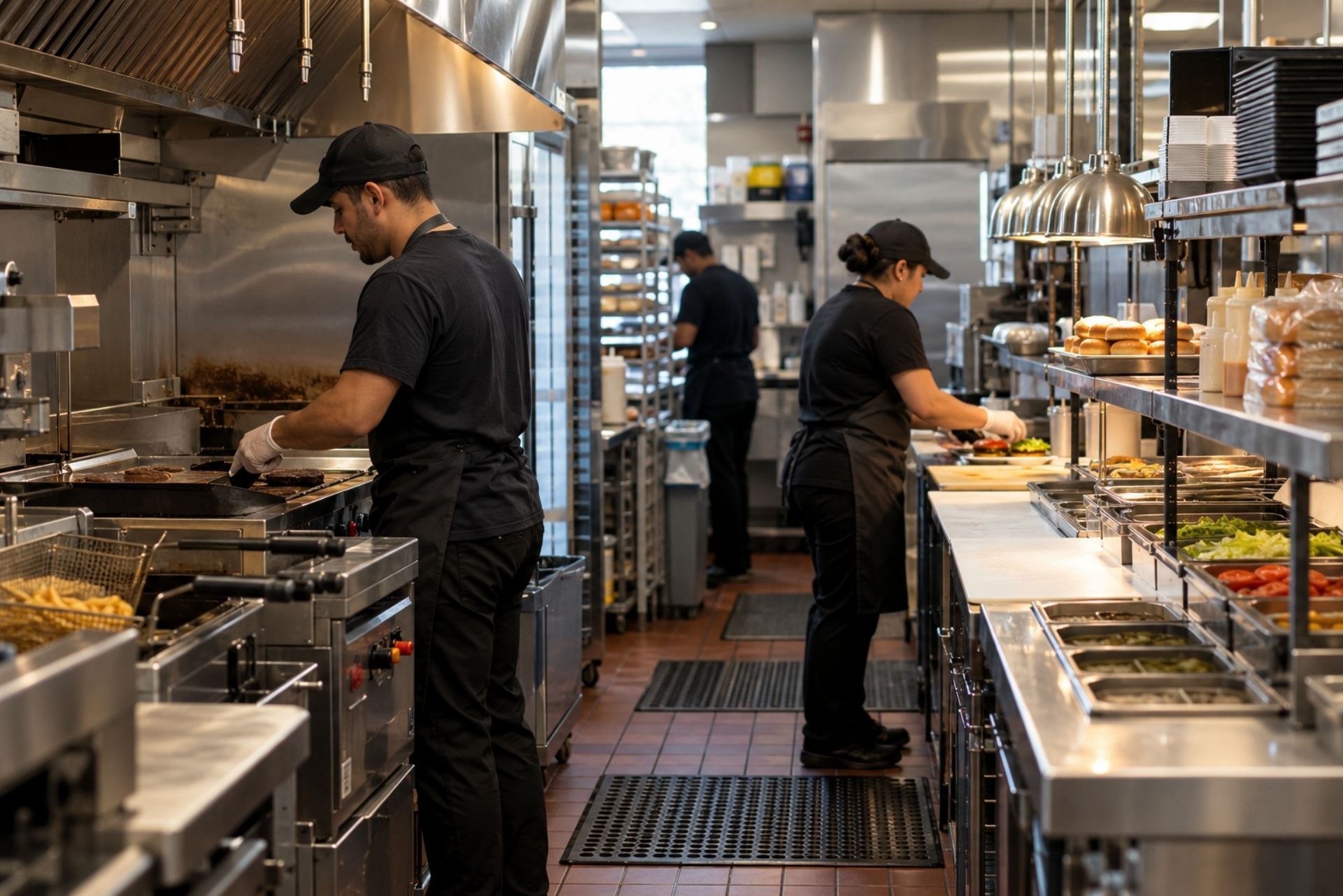
Commercial property insurance covers the building (if you own it), your tenant improvements, furniture, fixtures, and equipment. For franchise restaurants, the equipment list is substantial: commercial fryers, walk-in coolers, hood ventilation systems, POS terminals, and signage. Make sure your policy covers replacement cost rather than actual cash value. A five-year-old commercial oven might be worth $2,000 on a depreciated basis but cost $12,000 to replace.
Spoilage and Equipment Breakdown Coverage
Standard property policies often exclude mechanical breakdown and food spoilage. A compressor failure in your walk-in freezer on a Friday night can destroy thousands of dollars in inventory by Monday morning. Equipment breakdown coverage (sometimes called boiler and machinery) fills this gap. Spoilage coverage specifically reimburses you for perishable inventory lost due to equipment failure or power outages. These endorsements typically add modest cost to your property policy but can save you from absorbing a $5,000 to $15,000 loss.
Business Interruption: Staying Afloat During Repairs
If a covered event, like a fire or storm, forces you to close temporarily, business interruption insurance replaces your lost income and covers ongoing fixed expenses like rent, loan payments, and payroll. The waiting period (typically 48 to 72 hours) and coverage period (usually 12 months) matter. Review these carefully with your agent. A kitchen fire that takes three months to repair can cost you more in lost revenue than the physical damage itself.
Comparison: Standard BOP vs. Specialized Restaurant Packages
A Business Owner's Policy (BOP) bundles general liability and commercial property into a single policy, often at a lower combined premium. For many small franchise operations, a BOP is a sensible starting point. But standard BOPs have limitations that matter for restaurants.
| Feature | Standard BOP | Restaurant-Specific Package |
|---|---|---|
| General Liability | Included | Included |
| Commercial Property | Included | Included |
| Equipment Breakdown | Often excluded | Typically included |
| Spoilage Coverage | Usually excluded | Typically included |
| Food Contamination/Recall | Not available | Available as endorsement |
| Liquor Liability | Not available | Available as endorsement |
| HNOA Auto | Rarely included | Often available |
| Premium Range | Lower base cost | Higher, but fewer gaps |
A restaurant-specific package from a carrier experienced in food service will typically include endorsements that a generic BOP leaves out. The slightly higher premium often pays for itself the first time you file a spoilage or equipment claim.
Hired and Non-Owned Auto Coverage for Delivery Operations
With the continued growth of both third-party and in-house delivery, Hired and Non-Owned Auto (HNOA) insurance has become a core component rather than an optional add-on for restaurant operations. If your employees use personal vehicles for any business purpose, even running to the store for supplies, your general liability policy won't cover an accident. HNOA fills that gap.
Commercial auto premiums have been climbing steadily, with a 5.8% increase in Q1 2026 alone, marking the 59th consecutive quarterly increase. For pizza and delivery-heavy franchises, this coverage isn't optional. It's essential. Even if you rely on third-party delivery apps, confirm that your agreement with those platforms doesn't leave liability gaps that fall back on your restaurant.
Workforce and Management Liability
Your employees are your greatest asset and one of your biggest liability exposures. Protecting both them and yourself requires specific policies.
Workers' Compensation Compliance
Workers' compensation is mandatory in nearly every state, and restaurants are high-risk environments. Burns, cuts, repetitive strain injuries, and slips are common. Your premium is calculated based on your payroll, your state's rates, and your experience modification factor (mod rate). A clean safety record can lower your mod rate below 1.0, saving you thousands annually. Invest in non-slip mats, proper knife training, and burn prevention protocols. These aren't just good practices: they directly reduce your premiums over time.
Employment Practices Liability (EPLI)
EPLI protects you against claims of wrongful termination, discrimination, harassment, and wage disputes. Restaurants have high turnover and often employ younger, less experienced workers, which increases the frequency of employment-related claims. A single wrongful termination lawsuit can cost $75,000 or more in legal defense alone, even if you win. EPLI is rarely required by franchise agreements but is one of the smartest optional coverages you can carry.
Common Questions About Franchise Insurance
Does my franchisor's insurance cover my location? No. The franchisor's corporate policies protect the brand and corporate entity, not individual franchise locations. You're responsible for purchasing and maintaining your own policies that meet the FDD requirements.
Can I choose any insurance carrier, or do I have to use the franchisor's preferred provider? Most franchise systems allow you to choose your own carrier as long as the policy meets FDD specifications. Some systems, like McDonald's with GAIL, offer or require proprietary programs. Check your FDD for approved carrier lists.
What happens if I let my coverage lapse? A lapse puts you in default of your franchise agreement and potentially your lease. Your franchisor can force-place coverage at your expense, which is almost always more expensive than maintaining your own policy.
How can I lower my restaurant insurance premiums? Bundle policies into a BOP or restaurant package. Maintain a clean claims history. Install fire suppression and security systems. Keep your workers' comp mod rate low through safety training. Some carriers offer discounts for ServSafe certification.
Do I need cyber liability insurance?
If you process credit card transactions, yes. A data breach affecting customer payment information triggers notification costs, potential fines, and legal exposure. The median annual cost for cyber liability insurance across small businesses is approximately $1,552
(https://www.insureon.com/small-business-insurance/cyber-liability/cost).
Insurers reward franchise owners who actively reduce risk. Documented safety training programs, regular equipment maintenance logs, and ServSafe-certified managers all signal to underwriters that your operation is well-run. Carriers may offer premium discounts for bundling multiple policies. Others offer credits for fire suppression upgrades or security camera installations. Ask your agent specifically which loss-control measures qualify for discounts with your carrier.
How to Choose the Right Insurance Broker
Not every insurance broker understands franchise restaurant operations. Look for a broker or agent who specializes in hospitality or franchise insurance. They'll know which carriers write restaurant risks competitively, understand FDD compliance requirements, and can structure your program to avoid coverage gaps. Ask prospective brokers how many restaurant franchisees they currently insure and whether they can handle COI distribution to both your franchisor and landlord.
When to Review and Update Your Coverage
Review your insurance annually, at minimum. But certain events should trigger an immediate policy review: opening a second location, adding delivery service, remodeling your space, installing new equipment, or experiencing a significant claim. Your coverage needs will evolve as your operation grows. A policy that was adequate when you opened may leave dangerous gaps two or three years later.
Building a Multi-Unit Insurance Strategy
If you're scaling beyond a single location, your insurance strategy should scale with you. Multi-unit operators can often negotiate volume discounts, consolidate policies under a single program, and benefit from a single renewal date. A centralized insurance program also simplifies compliance reporting to your franchisor. Work with your broker to build a program that accommodates growth without requiring a complete restructuring each time you sign a new lease.
The Bottom Line for Your Franchise
Insurance for franchise restaurant owners isn't a single policy. It's a system of interlocking coverages that protect your investment from every angle: customer injuries, employee claims, equipment failures, delivery accidents, and forced closures. Your franchisor sets the floor with FDD requirements, but smart operators build above that floor based on their specific concept, location, and risk profile.
Start by reading your FDD insurance section and your lease requirements side by side. Identify the gaps between what's required and what you actually need. Then work with a broker who knows franchise restaurants and can build a program that keeps you compliant, protected, and positioned to grow. The cost of proper coverage is predictable. The cost of being underinsured is not.
About The Author:
Dustin Hulett
As Owner of Cuisine Coverage powered by Hulett Insurance, I specialize in protecting restaurants, bars, and hospitality businesses with smart, reliable insurance solutions. With years of experience serving the food and beverage industry, my goal is to make coverage simple, transparent, and built around the unique risks that owners face every day.
Contact Us
Business Coverage
Protection for Every Part of Your Food Business
Cuisine Coverage provides specialized insurance for restaurants, food trucks, catering services, and other hospitality businesses. We help owners protect their property, staff, and reputation with policies built around the most common industry risks.

General Liability Insurance
Protects your business from claims related to injury, property damage, or accidents that happen during operations.
General Liability
Liquor Liability Insurance
Covers alcohol-related incidents for restaurants, bars, or venues that serve or sell alcohol.
Liquor Liability
Workers Compensation Insurance
Provides wage replacement and medical benefits to employees injured on the job.
Workers Compensation
Business Interruption Insurance
Helps replace lost income and cover ongoing expenses if your business operations are temporarily halted.
Business Interruption
Product Liability Insurance
Protects against claims related to foodborne illness, contamination, or product defects.
Product Liability
Cyber Liability Insurance
Covers data breaches, online payment issues, and digital risks that can affect modern food businesses.
Cyber Liability
Serving the Food and Hospitality Industry
Insurance Solutions for Every Type of Food Business
Cuisine Coverage provides specialized insurance for restaurants, cafés, and food service professionals across the country. Whether you run a casual kitchen or a mobile food truck, we offer coverage that fits your operations and risk level.
How It Works
Insurance Made Easy for Food Business Owners
We know you don’t have time to deal with complicated insurance forms. That’s why our process is built for speed and simplicity — so you can get back to running your kitchen.
Your Insurance Questions Answered
What Restaurant and Food Business Owners Ask Most
What types of insurance do restaurants and food businesses need?
Most food businesses need general liability, property, and workers’ compensation coverage. These protect against injuries, equipment damage, and employee-related incidents. Businesses serving alcohol should also include liquor liability insurance for extra protection.
Having the right mix of policies helps reduce financial risks. We’ll help you identify the specific coverages your business needs based on your setup, size, and operations.
Do you provide insurance for food trucks and mobile kitchens?
Yes. We specialize in insurance for food trucks, trailers, and mobile vendors. Our coverage includes vehicle protection, cooking equipment, and liability for events or customer interactions.
We can also help you meet licensing and vendor requirements by issuing certificates of insurance quickly — often the same day.
How fast can I get a quote or start coverage?
In most cases, quotes are ready within 24 hours once we have your business details. After approval, coverage and certificates can be issued immediately.
Our process is fully digital but supported by real agents who review each policy for accuracy. You’ll always know exactly what you’re getting before coverage starts.
Do you offer liquor liability insurance for bars or restaurants?
Yes. We provide liquor liability insurance for bars, taverns, and restaurants that sell or serve alcohol. This coverage protects against claims involving intoxicated patrons or alcohol-related incidents.
It’s essential for maintaining compliance with local laws and protecting your business from costly lawsuits. We’ll ensure your policy meets all licensing requirements.
How can I reduce my insurance costs?
You can often lower premiums by bundling multiple coverages, maintaining clean safety records, and conducting regular policy reviews. Many insurers also offer discounts for installing safety systems and training employees.
At Cuisine Coverage, we proactively review your policy before renewal to help you keep costs down without reducing protection.
Do you help with certificates of insurance (COIs)?
Yes. We provide same-day certificates for vendors, landlords, and event partners. You can request them by phone or email anytime.
Having your COI ready keeps your business compliant and avoids delays in operations. Our team handles these requests quickly so you can stay focused on running your business.
From the Kitchen to Coverage
Real Advice for the Food and Hospitality Industry
We share tips, updates, and real-world stories from the food and insurance industries. Whether you’re managing a restaurant or rolling out a food truck, our articles give you useful guidance to protect your business and grow with confidence.
Contact Us
Phone
Location