Brazilian Steakhouse INSURANCE
OR call us: (214) 667-2729
A single grease fire, a slip on a freshly mopped tile floor, or a guest burned by a sizzling skewer can turn a profitable Saturday night into a six-figure liability claim. Brazilian steakhouses face a risk profile that most standard restaurant policies don't fully account for: open-flame churrasqueiras, continuous tableside meat service with long knives, high-volume liquor sales, and buffet-style salad bars that introduce food contamination exposure. These elements combine to make insurance for a churrascaria more complex, and often more expensive, than coverage for a typical sit-down restaurant.
Getting the right mix of
general liability, property,
workers' compensation, and
liquor liability coverage isn't just about checking a box for your landlord. It's a financial safety net that keeps your doors open after the unexpected. The costs vary widely based on your revenue, location, and how you manage risk in the kitchen and dining room. This guide breaks down the specific policies you need, what drives your premiums up or down, and how to avoid the coverage gaps that catch
steakhouse owners off guard.
Essential Insurance Policies for Brazilian Steakhouses
Every churrascaria needs a core set of policies before the first skewer hits the grill. Skipping one of these creates a gap that could wipe out years of profit in a single claim. Here's what belongs in your insurance portfolio and why each piece matters for this specific style of restaurant.
General Liability and Liquor Liability
General liability (GL) is your first line of defense against third-party claims: a guest who slips on the rodizio floor, a burn from a hot plate, or property damage caused by your operations. Landlords typically require specific minimum coverage limits for these policies. GL premiums for restaurants with clean loss histories are rising between 5% and 15% in 2026, while owners with recent claims can expect increases of 15% to 30%.
Liquor liability sits alongside GL but covers a distinct risk: claims arising from serving alcohol. If an intoxicated guest causes an accident after leaving your restaurant, you could be held liable under dram shop laws in most states. The liquor liability market remains tight in 2026, with some insurers exiting high-risk states entirely. If your bar revenue represents a significant portion of total sales, expect to pay more, and expect fewer carriers willing to write the policy.
Commercial Property and Equipment Breakdown
Your property policy covers the building (if you own it), your interior buildout, furniture, and business personal property. For a Brazilian steakhouse, that means insuring churrasqueira grills, rotisserie spits, commercial-grade charcoal or gas systems, walk-in coolers stocked with prime cuts, and custom decor like exposed brick or imported wood accents. Equipment breakdown coverage, sometimes called boiler and machinery, picks up where standard property leaves off by covering mechanical or electrical failure of your kitchen systems.
One bright spot: the hospitality property market has entered a soft cycle, with some accounts seeing premium reductions of 15% to 25% in 2026. That said, you need to document replacement costs accurately. A custom-built churrasqueira can be expensive to replace, and if your policy lists generic kitchen equipment values, you'll be underinsured when it matters most.
Workers' Compensation for Rodizio Service
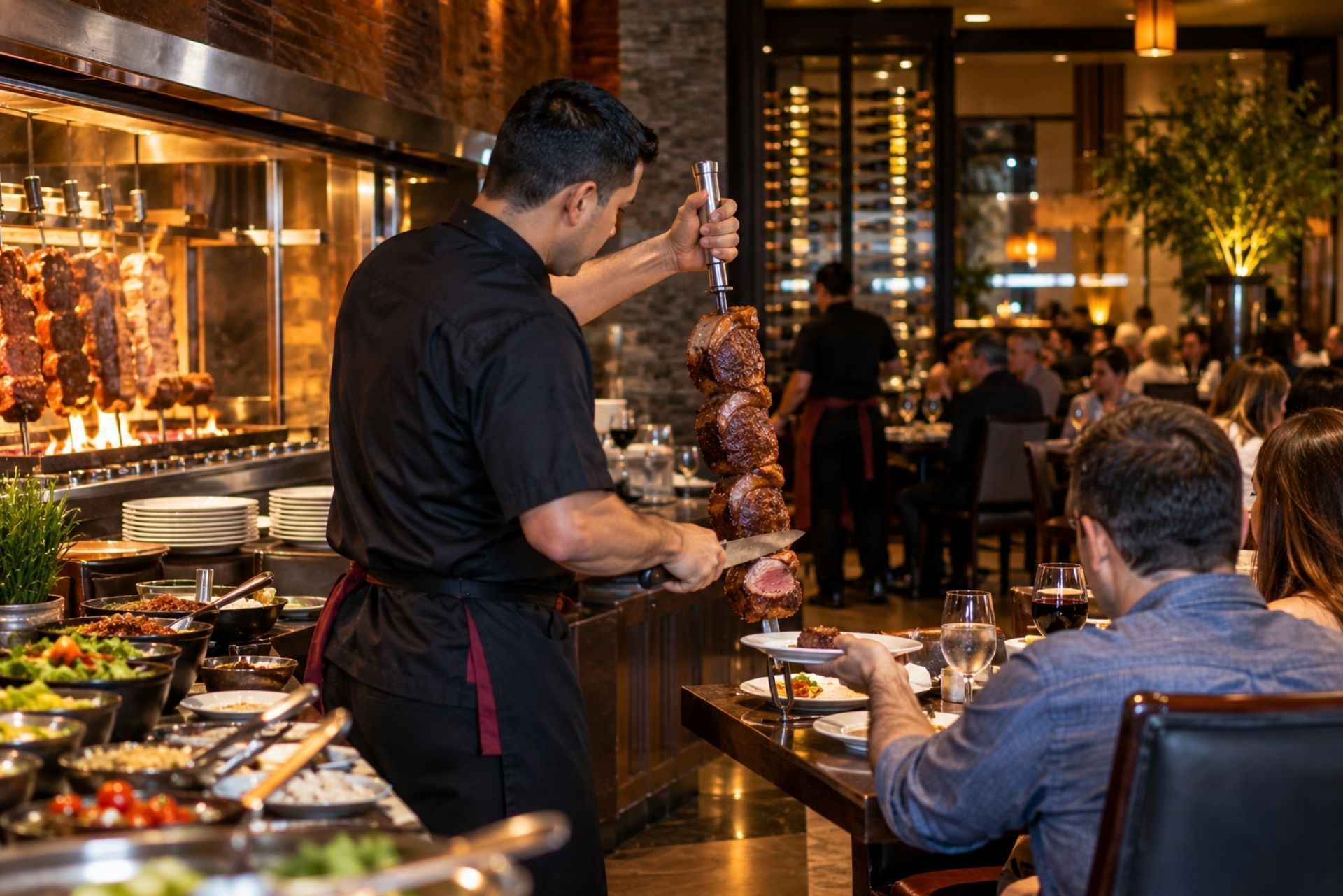
Workers' comp is mandatory in nearly every state, and rodizio-style service creates specific injury patterns. Passadores (meat carvers) perform repetitive slicing motions for hours while carrying heavy skewers across a dining room. Muscle strains from this repetitive carving and lifting are the most expensive workers' comp claims for steakhouses, costing nearly 500% more per claim than lacerations.
Average workers' comp rates for the restaurant industry in 2026 sit at roughly
$1.06 per $100 of payroll. Your actual rate depends on your state, your experience modification factor, and your claims history. A churrascaria with $600,000 in annual payroll could pay $6,360 or more per year before any modifiers are applied.

By: Dustin Hulett
Founder & CEO of Cuisine Coverage
Comparing Basic vs. Comprehensive Coverage Tiers
Not every steakhouse needs the same level of coverage, but understanding the difference between a bare-minimum policy and a comprehensive program helps you make informed decisions. A Business Owner's Policy (BOP) bundles GL and property into one package at a lower combined premium, but it often excludes liquor liability and equipment breakdown, both of which are essential for a churrascaria.
Coverage Comparison Table
| Coverage | Basic (BOP) | Comprehensive |
|---|---|---|
| General Liability | $1M per occurrence / $2M aggregate | $1M per occurrence / $2M aggregate |
| Commercial Property | Building + contents, basic perils | Building + contents, broad perils including equipment breakdown |
| Liquor Liability | Not included | $1M per occurrence (separate policy or endorsement) |
| Workers' Compensation | Required separately | Bundled or coordinated with carrier |
| Umbrella / Excess | Not included | $1M to $5M excess layer |
| Employment Practices (EPLI) | Not included | $500K to $1M for wrongful termination, harassment claims |
| Hired / Non-Owned Auto | Not included | Covers delivery drivers using personal vehicles |
| Food Contamination / Spoilage | Limited or excluded | Covers spoilage from power outage or equipment failure |
A basic BOP might offer a lower entry point for a smaller churrascaria. Comprehensive programs with umbrella coverage and EPLI can run significantly higher depending on revenue and location.
Your premium isn't a fixed number pulled from a rate card. Insurers weigh a dozen variables, and understanding them gives you room to negotiate or make changes that lower your costs.
Revenue, Square Footage, and Location
Annual revenue is the primary rating factor for GL. A steakhouse doing $3 million in sales pays significantly more than one doing $1.2 million, because higher revenue typically means more customers and more exposure. Square footage matters for property coverage: a 6,000-square-foot restaurant with a full bar costs more to insure than a 2,500-square-foot space.
Location drives pricing in ways you can't always control. A churrascaria in downtown Miami faces higher property premiums due to hurricane exposure, while one in a high-crime urban area may see theft surcharges. States with aggressive dram shop enforcement, like Texas and New Jersey, tend to push liquor liability premiums higher.
Open Flame and Specialty Kitchen Equipment Risks
This is where Brazilian steakhouse insurance diverges sharply from standard restaurant coverage. Open-flame grills burning wood or charcoal present a fire risk that insurers take seriously. Many carriers require documentation that your fire suppression system includes automatic fuel shut-off for gas and electric power sources that activates simultaneously with the suppression system.
If your churrasqueira doesn't meet these requirements, some insurers won't write the policy at all. Others will write it with exclusions or higher deductibles. Installing a UL 300-compliant hood suppression system and maintaining quarterly inspections can lower your premium and keep you from losing coverage mid-term.
Managing Risks Unique to Churrascaria Service
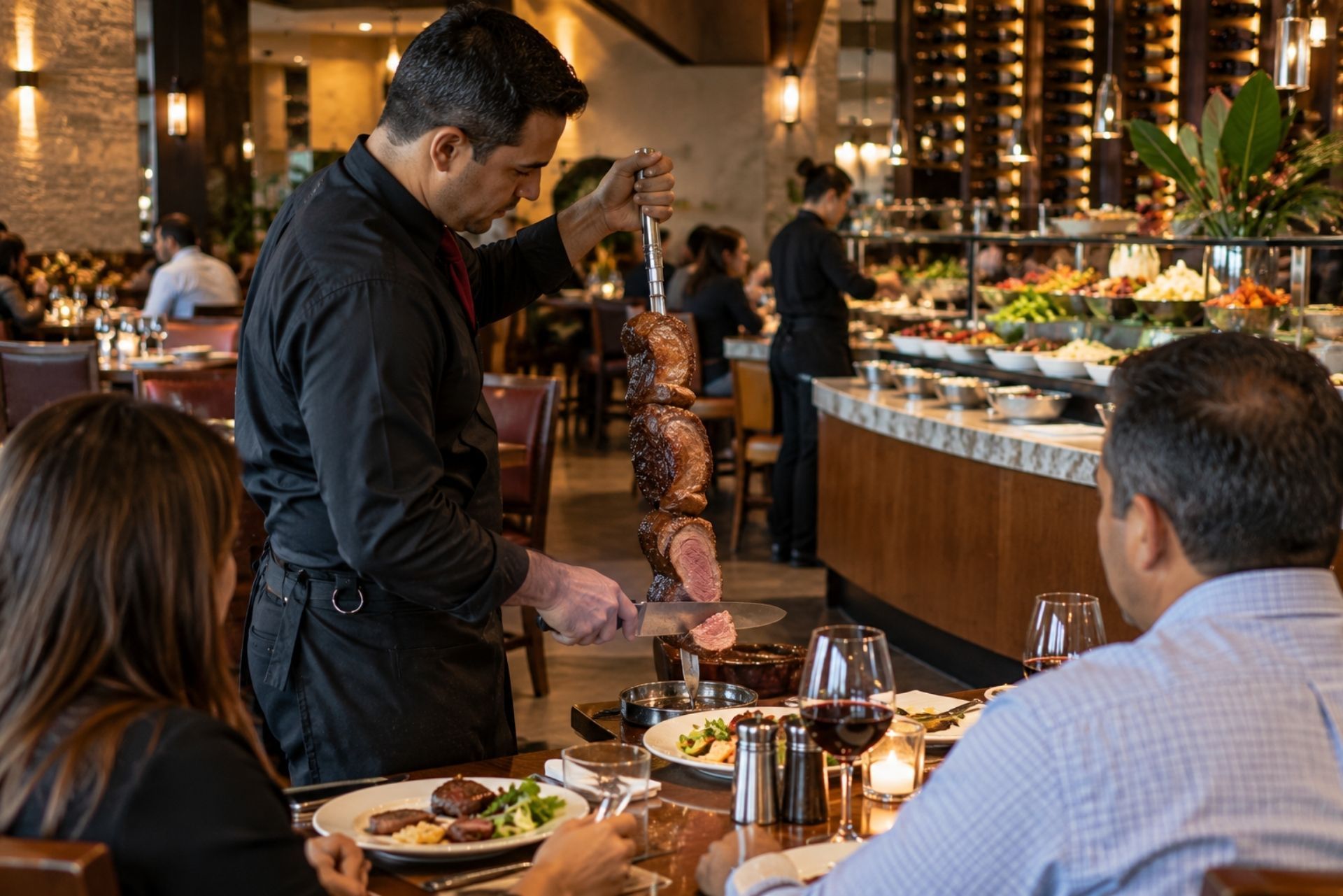
Brazilian steakhouses combine risks from multiple restaurant categories: buffet service, open-flame cooking, tableside knife work, and high-volume alcohol sales. Managing these risks proactively doesn't just prevent injuries. It directly affects what you pay for coverage.
Salad Bar Food Safety and Contamination
The traditional churrascaria salad bar, with its spread of cured meats, imported cheeses, marinated vegetables, and hot sides, creates a continuous food safety exposure. Items sit at serving temperature for hours, and cross-contamination between allergens is a constant concern. A single norovirus outbreak traced to your salad bar can generate dozens of claims simultaneously.
Regular temperature logging, sneeze guards that meet local health code, and dedicated tongs for each item are baseline practices. Your insurer may ask about your food safety training program during underwriting. ServSafe certification for managers can sometimes earn a small premium credit, and it demonstrates due diligence if a claim ever goes to court.
Knife Safety and Table-Side Service Hazards
Passadores carry razor-sharp carving knives through a crowded dining room, slicing meat inches from guests. This creates a liability exposure you won't find in most restaurants. A slip, a bump from a passing child, or a moment of inattention can result in a laceration claim from a guest or a workers' comp claim from the server.
Require cut-resistant gloves for all carving staff, establish clear traffic patterns in the dining room, and train passadores on safe knife presentation angles. Some insurers will ask about your knife safety protocols during the application process. Having a written policy with documented training records strengthens your position during both underwriting and claims.
Common Questions About Steakhouse Insurance
Does my landlord's insurance cover my restaurant? No. Your landlord's policy covers the building structure, not your equipment, inventory, liability, or business income. Your lease likely requires you to carry your own GL and property coverage and name the landlord as an additional insured on your policy.
Can I bundle all my coverage into one policy? A BOP bundles GL and property, but you'll need separate policies for liquor liability, workers' comp, and usually umbrella coverage. Some carriers offer restaurant-specific programs that coordinate all these under one account for easier management.
What happens if my churrasqueira doesn't meet fire suppression requirements? You may face policy exclusions for fire-related claims, higher deductibles, or outright denial of coverage. Getting your suppression system inspected and certified before applying for insurance avoids this problem.
How do I lower my workers' comp premiums? Focus on injury prevention, especially for repetitive strain injuries among carving staff. Rotate passadores between stations, invest in ergonomic knife handles, and report claims promptly. A clean three-year claims history can significantly reduce your experience modification factor.
Do I need coverage for catering or off-site events? Yes, if you cater. Your standard GL policy may not extend to off-premises locations. Ask your broker about a catering endorsement or a separate event policy for off-site rodizio service.
Before You Buy a Policy
Brazilian steakhouse insurance requires more than a generic restaurant policy. Your open-flame grills, tableside knife service, high-value meat inventory, and liquor sales each introduce exposures that need specific coverage. A basic BOP gets you started, but it leaves gaps that a single serious claim can exploit.
Start by documenting your equipment values, including that custom churrasqueira and your walk-in cooler full of picanha. Get your fire suppression system inspected and certified before you shop for quotes. Ask brokers about their experience with churrascaria or steakhouse accounts specifically, because a broker who understands rodizio service will spot coverage gaps that a generalist might miss.
Request quotes from at least three carriers, compare not just premiums but deductibles, exclusions, and coverage limits. The cheapest policy isn't the best policy if it excludes your biggest risk. Protect the business you've built by matching your coverage to the way you actually operate, from the grill to the guest's table.
About The Author:
Dustin Hulett
As Owner of Cuisine Coverage powered by Hulett Insurance, I specialize in protecting restaurants, bars, and hospitality businesses with smart, reliable insurance solutions. With years of experience serving the food and beverage industry, my goal is to make coverage simple, transparent, and built around the unique risks that owners face every day.
Contact Us
Business Coverage
Protection for Every Part of Your Food Business
Cuisine Coverage provides specialized insurance for restaurants, food trucks, catering services, and other hospitality businesses. We help owners protect their property, staff, and reputation with policies built around the most common industry risks.

General Liability Insurance
Protects your business from claims related to injury, property damage, or accidents that happen during operations.
General Liability
Liquor Liability Insurance
Covers alcohol-related incidents for restaurants, bars, or venues that serve or sell alcohol.
Liquor Liability
Workers Compensation Insurance
Provides wage replacement and medical benefits to employees injured on the job.
Workers Compensation
Business Interruption Insurance
Helps replace lost income and cover ongoing expenses if your business operations are temporarily halted.
Business Interruption
Product Liability Insurance
Protects against claims related to foodborne illness, contamination, or product defects.
Product Liability
Cyber Liability Insurance
Covers data breaches, online payment issues, and digital risks that can affect modern food businesses.
Cyber Liability
Serving the Food and Hospitality Industry
Insurance Solutions for Every Type of Food Business
Cuisine Coverage provides specialized insurance for restaurants, cafés, and food service professionals across the country. Whether you run a casual kitchen or a mobile food truck, we offer coverage that fits your operations and risk level.
How It Works
Insurance Made Easy for Food Business Owners
We know you don’t have time to deal with complicated insurance forms. That’s why our process is built for speed and simplicity — so you can get back to running your kitchen.
Your Insurance Questions Answered
What Restaurant and Food Business Owners Ask Most
What types of insurance do restaurants and food businesses need?
Most food businesses need general liability, property, and workers’ compensation coverage. These protect against injuries, equipment damage, and employee-related incidents. Businesses serving alcohol should also include liquor liability insurance for extra protection.
Having the right mix of policies helps reduce financial risks. We’ll help you identify the specific coverages your business needs based on your setup, size, and operations.
Do you provide insurance for food trucks and mobile kitchens?
Yes. We specialize in insurance for food trucks, trailers, and mobile vendors. Our coverage includes vehicle protection, cooking equipment, and liability for events or customer interactions.
We can also help you meet licensing and vendor requirements by issuing certificates of insurance quickly — often the same day.
How fast can I get a quote or start coverage?
In most cases, quotes are ready within 24 hours once we have your business details. After approval, coverage and certificates can be issued immediately.
Our process is fully digital but supported by real agents who review each policy for accuracy. You’ll always know exactly what you’re getting before coverage starts.
Do you offer liquor liability insurance for bars or restaurants?
Yes. We provide liquor liability insurance for bars, taverns, and restaurants that sell or serve alcohol. This coverage protects against claims involving intoxicated patrons or alcohol-related incidents.
It’s essential for maintaining compliance with local laws and protecting your business from costly lawsuits. We’ll ensure your policy meets all licensing requirements.
How can I reduce my insurance costs?
You can often lower premiums by bundling multiple coverages, maintaining clean safety records, and conducting regular policy reviews. Many insurers also offer discounts for installing safety systems and training employees.
At Cuisine Coverage, we proactively review your policy before renewal to help you keep costs down without reducing protection.
Do you help with certificates of insurance (COIs)?
Yes. We provide same-day certificates for vendors, landlords, and event partners. You can request them by phone or email anytime.
Having your COI ready keeps your business compliant and avoids delays in operations. Our team handles these requests quickly so you can stay focused on running your business.
From the Kitchen to Coverage
Real Advice for the Food and Hospitality Industry
We share tips, updates, and real-world stories from the food and insurance industries. Whether you’re managing a restaurant or rolling out a food truck, our articles give you useful guidance to protect your business and grow with confidence.
Contact Us
Phone
Location