Marco's Pizza Franchise INSURANCE
OR call us: (214) 667-2729
Most pizza franchise claims don't start in the kitchen. They start at a four-way stop at 9:40 on a Friday night, when a driver with a hot bag on the passenger seat rolls into someone's rear bumper. That single fender-bender can turn into a bodily injury lawsuit that names your store, your corporation, and the franchisor all at once.
Marco's Pizza owners operate in one of the most claim-heavy corners of quick-service food. You have open ovens running at high heat, a delivery fleet made up of employees' personal cars, a few hundred thousand dollars in equipment, and a franchise agreement that dictates what your policies must look like. Getting your coverage wrong doesn't just expose you to a bad claim. It can put you in technical default with the brand.
This guide covers the insurance side of owning a Marco's location:
delivery exposure, property and equipment, liability, staff, and the franchisor requirements that tie it all together. You'll find plain explanations of each policy, the gaps that trip up new owners, and practical ways to keep premiums in check without leaving yourself exposed. Use it as a working checklist before you sign a lease or open your doors.
Understanding Insurance Needs for a Marco's Pizza Franchise
Your insurance program has to answer two masters: the real risks inside your four walls and on the road, and the contract you signed with the franchisor. Here's how those pieces fit together.
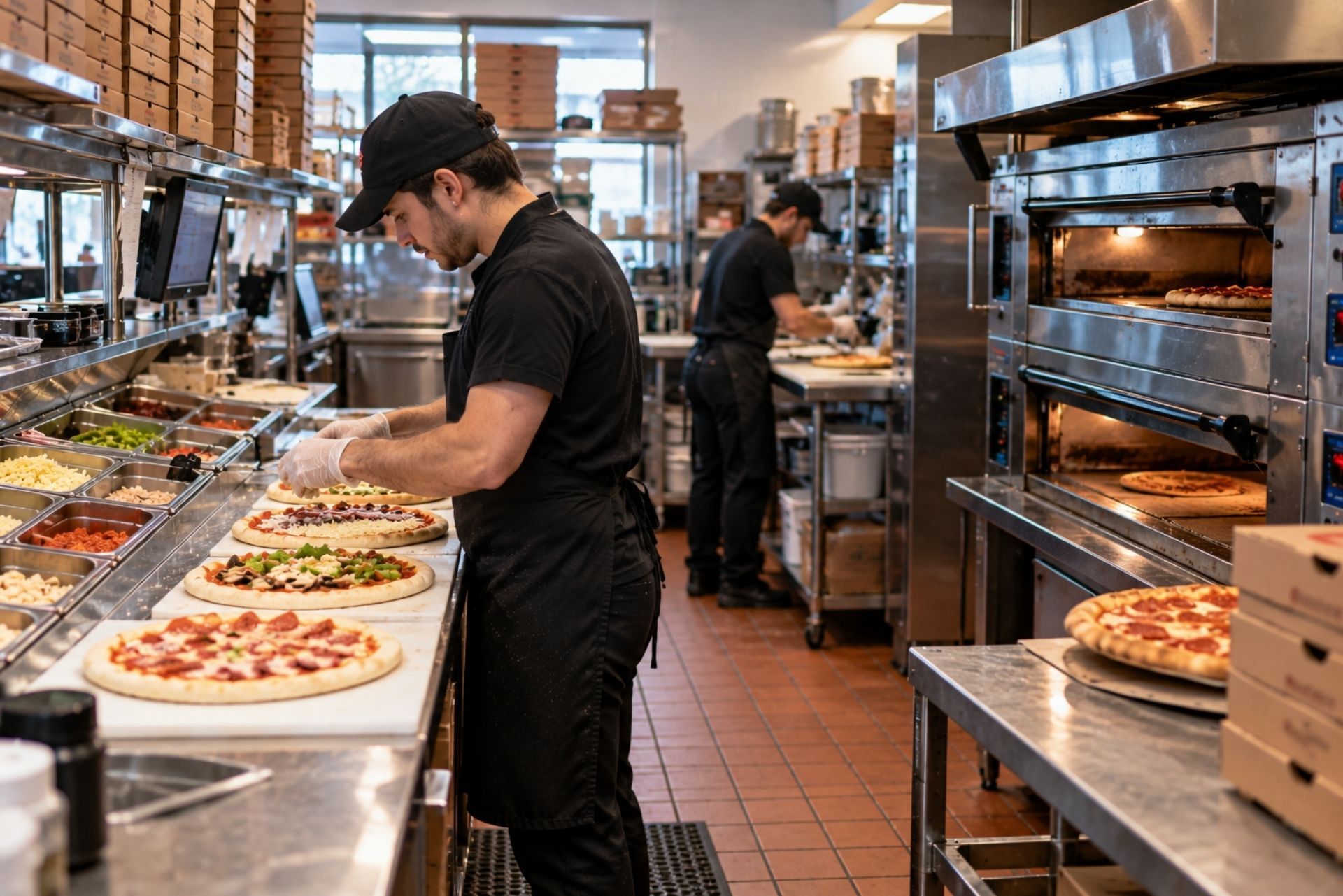
A Marco's store looks like a restaurant, but its risk profile is closer to a small logistics company with a kitchen attached. Delivery drives the bulk of your liability exposure. Ovens, fryers, and dough mixers drive your property and injury exposure. And because you're a franchisee, every policy you buy also has to satisfy a set of contract terms you didn't write.
The good news is that you're not budgeting blind. The franchise disclosure figures put the first-year insurance cost for a Marco's Pizza franchise between $2,366 and $16,500. That's a wide spread, and where you land depends on your state, your delivery volume, your claims history if you own other units, and how much of your build-out you're insuring.
Here's what that range usually reflects in real-world context:
- Low end: a single store in a lower-cost state, mostly carryout traffic, smaller payroll, and a bundled package policy
- High end: a delivery-heavy store in a litigious state, larger payroll, higher umbrella limits, and full replacement-cost property coverage
One thing to keep in mind: that figure covers your initial investment window, not every policy for every year. Workers' comp, in particular, gets audited against your actual payroll, so a busy first year can bring a bill at renewal. Build a cushion into your working capital for audit adjustments.
Insurance also does a job beyond paying claims. Landlords, lenders, and the franchisor all want proof that a single bad night won't wipe you out. A clean, well-structured program makes you easier to finance and easier to approve for a second unit.
By: Dustin Hulett
Founder & CEO of Cuisine Coverage
Standard Franchisor Insurance Requirements for Marco's
The franchise agreement sets your floor. Below, you'll see the two areas where franchisees most often run into trouble: liability limits and how the franchisor is listed on your policies.
Every franchisor protects its brand by requiring franchisees to carry specific coverage. Marco's makes this easier than most by offering a group program. The brand works with HUB International as a preferred vendor, using the buying power of more than 1,100 locations to secure competitive pricing for franchisees.
That program bundles the core lines you'll need: a Business Owner's Policy (BOP), general liability, property, umbrella, cyber, and hired and non-owned auto. You're not always forced to use it, but it gives you a baseline to measure outside quotes against. If an independent broker beats the price, make sure they also match every coverage term, not just the premium.
General Liability and Umbrella Coverage
General liability covers third-party bodily injury and property damage. Picture a customer who slips on a wet floor near the pickup counter, or a guest who claims a slice caused an allergic reaction. GL pays for their medical bills, your defense, and any settlement, up to your limits.
Restaurant GL is commonly written at $1 million per occurrence and $2 million aggregate. That sounds like a lot until you see a serious injury verdict. That's where the umbrella comes in. It sits on top of your GL, employer's liability, and auto liability, extending your limits when a claim blows past the underlying policy.
The catch is that umbrellas only follow form on listed underlying policies. If your hired and non-owned auto isn't scheduled under the umbrella, a six-figure delivery crash might not get the extra protection you assumed you had. Ask your broker to confirm, in writing, which policies the umbrella covers.
Minimum Coverage Limits and Named Insureds
Your exact required limits live in your franchise agreement and operations manual. Pull them before you shop, because brokers quoting "standard restaurant coverage" may come in below what the brand requires. Common items to check include:
- Minimum per-occurrence and aggregate GL limits
- Required umbrella limit
- Additional insured status for the franchisor and its affiliates
- Waiver of subrogation in favor of the franchisor
- Notice of cancellation requirements, often 30 days
- Carrier financial rating minimums
Additional insured status matters more than most owners realize. It lets the franchisor tap your policy if they're dragged into a lawsuit over your store. Your landlord will want the same status, so get both endorsements added before you open, not after the first certificate request bounces back.
Managing High-Risk Delivery Operations
Delivery is where pizza franchises take their biggest hits. This section explains the coverage that protects you when drivers use their own cars, and the habits that keep those claims from happening.
Hired and Non-Owned Auto Liability (HNOA)
Most Marco's drivers use their personal vehicles. When one of them causes a crash on a delivery, the injured party's attorney won't stop at the driver. They'll go after the business that sent the driver out, because your pockets are deeper than a 20-year-old's minimum-limit auto policy.
HNOA covers your business's liability in that situation. It responds when an employee uses their own car, or a car you rent, for work purposes. It's included in the Marco's group program for good reason.
Here's what HNOA does not do, and it's the gap that catches owners off guard:
- It doesn't repair the driver's car
- It doesn't cover the driver's own injuries (that's workers' comp)
- It doesn't replace the driver's personal auto policy, which usually responds first
That last point creates a second gap. Many personal auto policies exclude delivery for pay. If your driver's carrier denies the claim, your HNOA may end up as the primary payer on a claim it was priced as excess. Require drivers to carry personal auto policies that permit business use, and keep proof on file.
Safety Protocols to Lower Premium Costs
Underwriters price delivery risk based on how you manage drivers. A tight program can make a real difference at renewal. Put these steps in place before your first delivery:
- Pull motor vehicle records for every driver at hire and once a year after
- Set a written disqualification standard, such as recent DUIs or multiple at-fault accidents
- Collect and track proof of personal auto insurance and valid registration
- Ban phone use while driving, including checking delivery apps
- Remove "30 minutes or free" style pressure from your store culture
- Document every incident, even minor ones, the same day
That documentation pays off. When a claim lands, a file showing you checked the driver's record and enforced a phone policy gives your defense attorney something to work with.
Protecting Physical Assets and Pizza Equipment
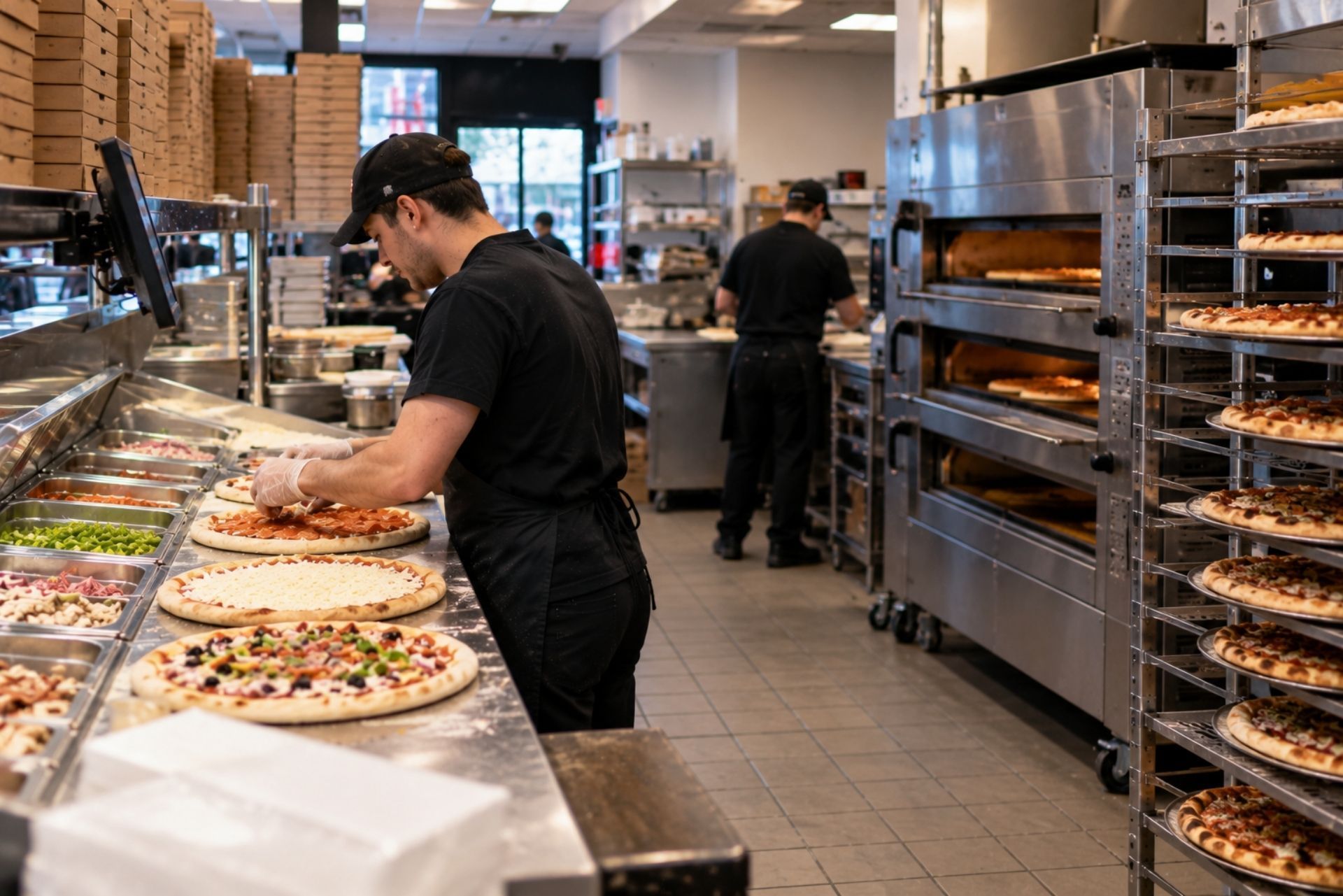
Your build-out is the biggest check you'll write after the franchise fee. This section covers how to insure the ovens, POS hardware, and inventory that keep orders moving.
Commercial Property and Equipment Breakdown Insurance
The franchise disclosure figures place equipment and fixtures at a Marco's location between $97,725 and $175,000. That's conveyor ovens, walk-in coolers, dough mixers, prep tables, hood systems, and signage. Commercial property insurance protects that investment against fire, theft, vandalism, and storm damage.
Insure everything at replacement cost, not actual cash value. ACV subtracts depreciation, so a three-year-old oven destroyed in a fire might only pay out a fraction of what a new one costs. On a conveyor oven, that gap can be a five-figure hit.
Your technology needs the same attention. The POS computer system alone runs between $20,000 and $23,000, and you're responsible for insuring that hardware against physical damage and electrical surges. Keep a written schedule with serial numbers, purchase invoices, and photos of every major item. Include your leasehold improvements too: tile, branded wall graphics, custom counters, and lighting.
Standard property coverage usually excludes mechanical and electrical failure. Equipment breakdown insurance fills that gap. If your walk-in compressor dies or a power surge fries your oven's control board, breakdown coverage pays for repair and the lost income while you're down.
Spoilage Coverage for Perishable Inventory
A pizza shop's walk-in holds cheese, pepperoni, sausage, fresh dough, and produce. Lose power for eight hours on a July weekend and that inventory is trash. Spoilage coverage pays to replace it, whether the cause is equipment failure or a utility outage.
Watch for two limits here. First, many policies cap spoilage at a low sublimit, sometimes too low for a fully stocked walk-in after a truck delivery. Second, off-premises power outage coverage often needs its own endorsement. Ask about both, and pair the coverage with temperature alarms that text your phone.
Employee Protection and Workplace Safety
Your crew faces burns, cuts, slips, and road risk every shift. Here's the coverage that protects them and protects you from claims they might bring.
Workers' Compensation and Employment Practices Liability
Workers' compensation and Employment Practices Liability Insurance (EPLI) are standard for franchise operators, covering medical costs and lost wages on one side and wrongful termination claims on the other. Workers' comp is also mandatory in nearly every state once you have employees, and rules vary. Texas lets most private employers opt out, while states like Ohio, Washington, and Wyoming require coverage through a state fund instead of private carriers.
Typical pizza store comp claims include oven burns, knife cuts during prep, back strains from lifting cheese cases, and slip-and-falls near the dish pit. Delivery drivers add auto injury exposure. Comp pays medical bills and a portion of lost wages, and in exchange, the employee generally can't sue you for the injury.
Premiums run on payroll and job classification, then get adjusted after an annual audit. A common mistake is misclassifying drivers or underestimating payroll to cut the deposit. That creates an audit bill later.
EPLI covers a different risk entirely. It responds to claims of wrongful termination, harassment, discrimination, and retaliation. Quick-service restaurants have high turnover and young workforces, which makes these claims more frequent than owners expect. A single harassment claim can cost five figures just to defend, even if you win.
EPLI is often sold as an endorsement, but standalone policies usually offer broader terms. Ask whether wage-and-hour claims are covered. Most policies exclude them or offer only a small defense sublimit, and overtime disputes are common in food service. Clear written policies, documented training, and consistent discipline records lower your premium and strengthen your defense.
Comparing Essential vs. Optional Coverage Packages
Not every policy carries the same weight. This comparison separates the coverage you can't operate without from the add-ons that close specific gaps.
The Marco's group program, built around Marco's Pizza franchise insurance needs, covers most of the essentials in one place. The decisions you'll face are mostly about limits and endorsements. Use this chart as a starting point with your broker.
| Coverage | Status | What It Covers | Common Gap |
|---|---|---|---|
| General Liability | Essential | Customer injuries, property damage | Low limits for serious injuries |
| HNOA | Essential | Liability for drivers' personal cars | Driver policy excludes delivery |
| Workers' Comp | Essential (most states) | Employee injuries, lost wages | Payroll audit surprises |
| Commercial Property | Essential | Equipment, fixtures, build-out | ACV instead of replacement cost |
| Umbrella | Essential (franchise) | Extra limits above underlying policies | Auto not scheduled underneath |
| EPLI | Strongly advised | Harassment, wrongful termination | Wage-and-hour exclusion |
| Equipment Breakdown | Recommended | Mechanical and electrical failure | Not included in base property |
| Spoilage | Recommended | Lost perishable inventory | Low sublimit |
| Cyber | Recommended | Data breach, ransomware | Denied for weak security |
| Business Interruption | Recommended | Lost income during closures | Short waiting period limits |
Cyber deserves extra attention in 2026. Your POS processes card data, and online ordering adds more exposure. Carriers have tightened up hard: cyber coverage now works like a security qualification process, and businesses that can't show basic defenses get declined. Expect questions about multi-factor authentication, backups, and employee training before you get a quote.
A BOP can bundle GL, property, and business interruption at a lower price than buying each separately. Pair it with fire suppression maintenance records and ServSafe-certified managers, and you'll give underwriters reasons to price you favorably.
Common Questions About Marco's Pizza Insurance
Below are short answers to the questions new franchisees ask most often about coverage, costs, and contracts.
Do I have to buy insurance through Marco's preferred program? Usually not, but your policies must meet every requirement in your franchise agreement. The HUB International program is a convenient benchmark for comparing outside quotes.
How much does insurance cost for a new Marco's location? Disclosure figures estimate first-year insurance between $2,366 and $16,500. Your state, payroll, and delivery volume will decide where you fall.
Will my landlord need to be listed on my policy? Almost always. Most commercial leases require additional insured status, specific GL limits, and a waiver of subrogation, so send your lease to your broker before signing.
Does my driver's personal auto policy cover delivery crashes? Often it doesn't, since many personal policies exclude delivery for pay. That's why HNOA matters and why you should verify each driver's coverage allows business use.
Why would a claim get denied? Common reasons include late reporting, unlisted equipment, coverage that was never endorsed, or a lapse from missed payments. Report incidents fast and review your policy schedule each year.
Should I use a broker who specializes in franchises? Yes, if you can. A broker who knows Marco's franchise requirements will catch contract gaps that a generalist might miss.
The Bottom Line for Franchise Owners
Your coverage needs boil down to a few priorities. Delivery liability is your largest exposure, so treat HNOA, driver screening, and umbrella scheduling as a single system. Insure your equipment and POS at replacement cost, document every high-value item, and add breakdown and spoilage coverage so a dead compressor doesn't turn into a lost weekend.
On the people side, get workers' comp classifications right from day one and pair them with EPLI that addresses wage-and-hour risk. Then read your franchise agreement and lease line by line, because missing an additional insured endorsement can create problems long before any claim does.
Your next step: pull your franchise agreement's insurance section, request a quote from the Marco's group program, and get at least one competing quote from a franchise-focused broker. Compare them term by term, not just on price. The cheapest policy is the one that pays when your driver has a bad Friday night.
About The Author:
Dustin Hulett
As Owner of Cuisine Coverage powered by Hulett Insurance, I specialize in protecting restaurants, bars, and hospitality businesses with smart, reliable insurance solutions. With years of experience serving the food and beverage industry, my goal is to make coverage simple, transparent, and built around the unique risks that owners face every day.
Contact Us
Business Coverage
Protection for Every Part of Your Food Business
Cuisine Coverage provides specialized insurance for restaurants, food trucks, catering services, and other hospitality businesses. We help owners protect their property, staff, and reputation with policies built around the most common industry risks.

General Liability Insurance
Protects your business from claims related to injury, property damage, or accidents that happen during operations.
General Liability
Liquor Liability Insurance
Covers alcohol-related incidents for restaurants, bars, or venues that serve or sell alcohol.
Liquor Liability
Workers Compensation Insurance
Provides wage replacement and medical benefits to employees injured on the job.
Workers Compensation
Business Interruption Insurance
Helps replace lost income and cover ongoing expenses if your business operations are temporarily halted.
Business Interruption
Product Liability Insurance
Protects against claims related to foodborne illness, contamination, or product defects.
Product Liability
Cyber Liability Insurance
Covers data breaches, online payment issues, and digital risks that can affect modern food businesses.
Cyber Liability
Serving the Food and Hospitality Industry
Insurance Solutions for Every Type of Food Business
Cuisine Coverage provides specialized insurance for restaurants, cafés, and food service professionals across the country. Whether you run a casual kitchen or a mobile food truck, we offer coverage that fits your operations and risk level.
How It Works
Insurance Made Easy for Food Business Owners
We know you don’t have time to deal with complicated insurance forms. That’s why our process is built for speed and simplicity — so you can get back to running your kitchen.
Your Insurance Questions Answered
What Restaurant and Food Business Owners Ask Most
What types of insurance do restaurants and food businesses need?
Most food businesses need general liability, property, and workers’ compensation coverage. These protect against injuries, equipment damage, and employee-related incidents. Businesses serving alcohol should also include liquor liability insurance for extra protection.
Having the right mix of policies helps reduce financial risks. We’ll help you identify the specific coverages your business needs based on your setup, size, and operations.
Do you provide insurance for food trucks and mobile kitchens?
Yes. We specialize in insurance for food trucks, trailers, and mobile vendors. Our coverage includes vehicle protection, cooking equipment, and liability for events or customer interactions.
We can also help you meet licensing and vendor requirements by issuing certificates of insurance quickly — often the same day.
How fast can I get a quote or start coverage?
In most cases, quotes are ready within 24 hours once we have your business details. After approval, coverage and certificates can be issued immediately.
Our process is fully digital but supported by real agents who review each policy for accuracy. You’ll always know exactly what you’re getting before coverage starts.
Do you offer liquor liability insurance for bars or restaurants?
Yes. We provide liquor liability insurance for bars, taverns, and restaurants that sell or serve alcohol. This coverage protects against claims involving intoxicated patrons or alcohol-related incidents.
It’s essential for maintaining compliance with local laws and protecting your business from costly lawsuits. We’ll ensure your policy meets all licensing requirements.
How can I reduce my insurance costs?
You can often lower premiums by bundling multiple coverages, maintaining clean safety records, and conducting regular policy reviews. Many insurers also offer discounts for installing safety systems and training employees.
At Cuisine Coverage, we proactively review your policy before renewal to help you keep costs down without reducing protection.
Do you help with certificates of insurance (COIs)?
Yes. We provide same-day certificates for vendors, landlords, and event partners. You can request them by phone or email anytime.
Having your COI ready keeps your business compliant and avoids delays in operations. Our team handles these requests quickly so you can stay focused on running your business.
From the Kitchen to Coverage
Real Advice for the Food and Hospitality Industry
We share tips, updates, and real-world stories from the food and insurance industries. Whether you’re managing a restaurant or rolling out a food truck, our articles give you useful guidance to protect your business and grow with confidence.
Contact Us
Phone
Location